
A teaser is a parlay’s more disciplined cousin. Like a parlay, it combines multiple selections into a single bet where every leg must win. Unlike a parlay, a teaser moves the point spread in your favor by a fixed number of points across all legs, in exchange for a reduced payout. The trade is straightforward: you get a more favorable number, but you pay for it with a lower return.
In the NFL, teasers occupy a unique strategic position. While standard parlays carry compounding vig that makes them negative expected value for almost everyone, properly constructed NFL teasers have been shown to produce positive expected value under specific conditions. This is not a theoretical curiosity. It is one of the most well-documented edges in football betting literature, widely associated with the research of Stanford Wong, whose work on teaser strategy remains influential decades after its original publication.
The Basic Structure of NFL Teasers
A standard NFL teaser gives you 6 extra points on the spread for each leg of your bet. If the original spread is Chiefs -7.5, a 6-point teaser moves it to Chiefs -1.5. If the original spread is Bills +3, the teaser moves it to Bills +9. Every leg gets the same 6-point adjustment, and every leg must cover its adjusted spread for the teaser to pay.
The most common teaser structures are two-team 6-point teasers and two-team 7-point teasers. A two-team 6-point teaser at standard pricing pays -110, meaning you risk $110 to win $100. A two-team 7-point teaser typically pays -130 or -120, depending on the sportsbook. Three-team and four-team teasers are available but carry the same compounding risk as larger parlays: each additional leg reduces your win probability significantly while the payout increase does not fully compensate.
The payout on a teaser is substantially lower than on a parlay with the same number of legs. A two-leg parlay at -110 on each side pays roughly 2.64 to 1. A two-leg 6-point teaser at -110 pays even money. You are sacrificing more than 60% of the parlay’s payout in exchange for 6 points of spread movement on each leg. Whether that trade is worth it depends entirely on how much those 6 points increase your probability of winning each leg.
The Math Behind 6-Point Teasers
The profitability of a teaser hinges on one question: does the 6-point adjustment increase your win probability per leg enough to overcome the reduced payout? For a two-team teaser at -110, you need to win both legs. If each leg has a win probability of P, the combined probability of winning the teaser is P squared. At -110, the breakeven probability for the teaser as a whole is approximately 52.4%, which means each individual leg needs to win about 72.4% of the time for the teaser to break even.
That sounds like a high bar, and it is. An 85% win rate on adjusted spreads is not achievable on random selections. But it is achievable when you select legs strategically, specifically by teasing through the key numbers of 3 and 7 in NFL games.
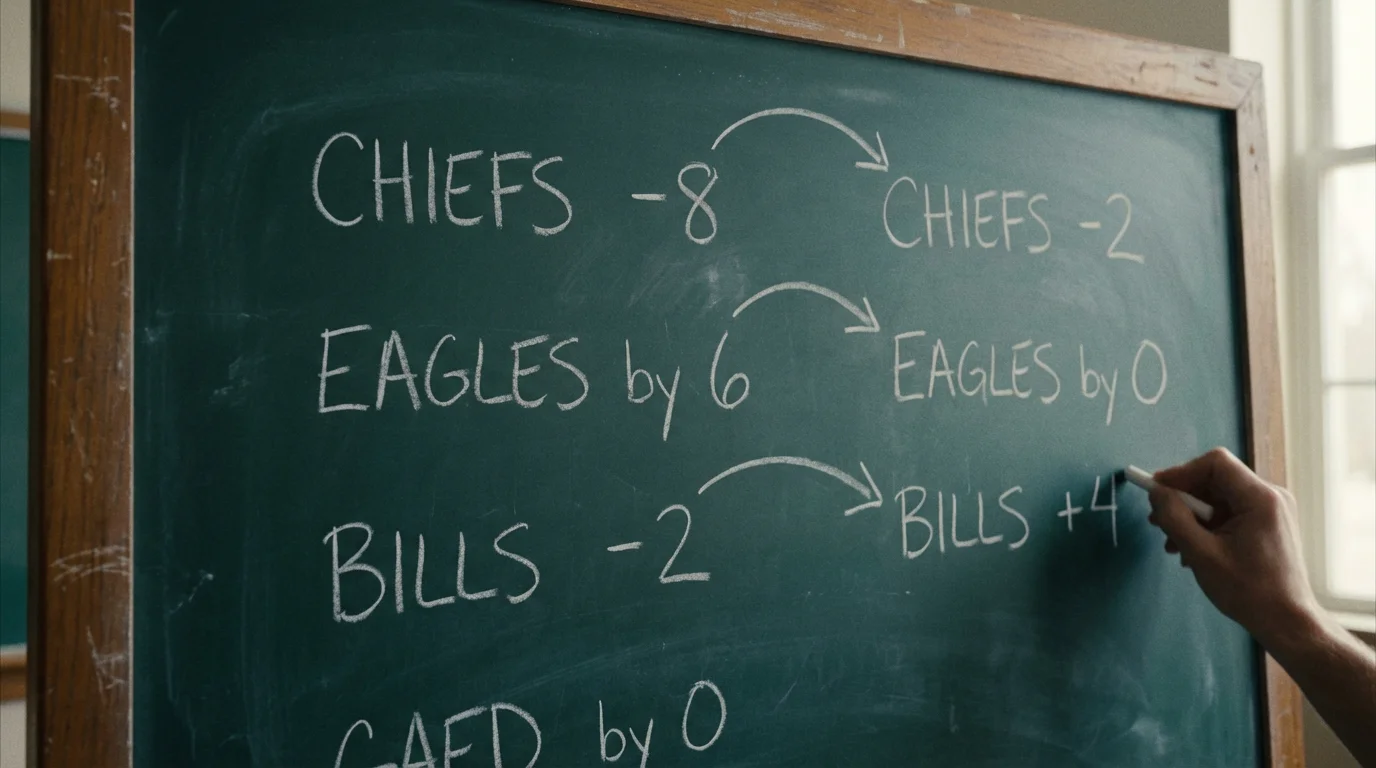
As discussed in the context of spread betting, the numbers 3 and 7 are the most common final margins in NFL games. About 15% of games are decided by exactly 3 points, and about 9% are decided by exactly 7. A 6-point teaser that moves a spread from +1.5 to +7.5 crosses both key numbers of 3 and 7, capturing a large portion of the final-margin distribution. A teaser that moves a spread from -8 to -2 also crosses 7 and 3. These teasers convert a significant number of would-be losses and pushes into wins.
Historical data from NFL games supports the viability of this approach. Two-team 6-point teasers with legs that cross both 3 and 7 have historically produced win rates in the 72-76% range on individual legs, which translates to combined teaser win rates above the 52.4% breakeven threshold at -110 pricing. This is the core of the Wong teaser strategy: only tease through key numbers, and the math works in your favor.
Wong Teasers: The Optimal Leg Selection
Stanford Wong’s research identified the specific spread ranges that produce positive expected value when teased 6 points. The Wong teaser strategy selects only legs that cross both 3 and 7, creating the maximum probability increase from the 6-point adjustment.
The ideal Wong teaser legs for favorites are spreads between -1 and -2.5. Teasing these 6 points gives you -7 to -8.5 adjusted, but more importantly, the original spread at -1 to -2.5 means you are moving through 3 and capturing the enormous cluster of games decided by a field goal. For underdogs, the ideal legs are spreads between +1.5 and +2.5. Teasing these 6 points gives you +7.5 to +8.5, crossing both 3 and 7 on the way up.
A secondary tier of Wong teaser legs includes favorites at -7.5 to -8.5, which tease down through 7 and 3 to -1.5 to -2.5. These legs cross key numbers in the opposite direction but capture the same probability boost. Underdogs at +7.5 to +8.5 teased to +13.5 to +14.5 cross through 10 and 14, which are secondary key numbers with smaller but still meaningful frequency clusters.
The legs to avoid in teasers are those that do not cross key numbers. A spread of -4 teased to +2 crosses 3 but not 7. A spread of -11 teased to -5 crosses 7 and 10 but the probability gain is smaller because the starting point is already far from the most important key numbers. Not all 6-point adjustments are created equal, and the Wong strategy is fundamentally about selecting only the adjustments that move through the highest-frequency margins.
7-Point Teasers: More Points, Higher Price
Seven-point teasers add an extra point of movement compared to the standard 6-point version. This additional point gives you slightly more margin, but the trade-off is a worse payout, typically -130 or -120 for a two-team version compared to -110 for a 6-point teaser.
The breakeven math shifts accordingly. At -130, you need a combined teaser win rate of roughly 56.5%, which requires each individual leg to win about 75.2% of the time. The extra point of movement does increase each leg’s win probability, but whether it increases it enough to justify the payout reduction depends on the specific spreads you are teasing.
Seven-point teasers shine in one specific scenario: when the extra point moves you through an additional key number that the 6-point teaser misses. If a spread is at -3, a 6-point teaser gives you +3, which pushes on the most common margin. A 7-point teaser gives you +4, which clears the 3 entirely and avoids the push. In this case, the extra point is disproportionately valuable because it eliminates the push risk on the single most important number in NFL betting.
Outside of these key-number-crossing scenarios, 7-point teasers are generally worse bets than 6-point teasers. The additional point provides diminishing returns in probability improvement while the reduced payout increases the breakeven threshold. If your selected legs already cross both 3 and 7 with a 6-point teaser, adding a seventh point gives you marginal probability improvement at a non-marginal cost. Stick with the 6-point teaser unless the seventh point specifically crosses a key number that the sixth does not.
Teaser Pricing Across Sportsbooks: Why It Matters
Not all sportsbooks price teasers identically, and the pricing differences are large enough to turn a marginally profitable strategy into a clearly profitable one or vice versa. The critical variables are the payout odds and the push rules.
Standard two-team 6-point teaser pricing at -110 is the baseline that Wong’s research used. Some sportsbooks offer -105 or even +100 on two-team teasers, which lowers the breakeven win rate and increases the expected value of properly constructed Wong teasers. Other sportsbooks price their teasers at -120 or worse, which narrows the margin to the point where even optimal leg selection may not produce positive expected value after accounting for variance.
Push rules are equally important. Some sportsbooks grade a teaser as a loss if any leg pushes. Others reduce the teaser by one leg, so a two-team teaser with one push becomes a straight bet on the remaining leg. The difference is enormous. Under “pushes lose” rules, any leg that lands exactly on the teased number kills the entire bet. Under “pushes reduce” rules, a push on one leg still gives you a chance to win on the other. The Wong strategy’s expected value calculations assume “pushes reduce” rules. Under “pushes lose” rules, the math deteriorates significantly, and some Wong teaser legs that are profitable under one ruleset become marginal or unprofitable under the other.
Before incorporating teasers into your betting strategy, compare pricing and push rules across every sportsbook where you have an account. The sportsbook with the best teaser terms might not be the same one that offers the best spread or moneyline prices. Using the optimal book for each bet type is a form of line shopping that applies to teasers just as much as it does to standard sides and totals.
Why Teasers Work in the NFL but Not in College Football
The Wong teaser strategy is specific to the NFL, and attempting to replicate it in college football is a common and costly mistake. The reason is structural: college football’s scoring distribution does not cluster around 3 and 7 with the same intensity as the NFL’s.
NFL games are decided by 3 points roughly 15% of the time because the professional game is tight, and field goals often determine the outcome in the final minutes. College football games feature wider talent gaps, more frequent blowouts, and a scoring distribution that is flatter across margins. The key numbers of 3 and 7 still matter in college, but their frequency advantage over adjacent numbers is smaller, which reduces the probability boost from teasing through them.
Additionally, college football spreads are often much larger than NFL spreads. Teasing a -28 college spread to -22 does not cross any meaningful key number, and the probability of covering is not substantially improved by the 6-point adjustment at that range. The Wong strategy works because it exploits a specific mathematical feature of NFL scoring. That feature is weaker in college football, and the teaser payout structure does not compensate for the reduced probability advantage.
If you want to use teasers in college football, the only potentially viable approach involves games with small spreads, typically under 8 points, where the 6-point adjustment crosses 3 and 7 in the same way it does in NFL games. But these games represent a small fraction of the college football slate, and the available sample of qualifying legs in any given week is often insufficient to construct a two-team teaser. In practice, teasers are an NFL-specific tool.
The Patience Teasers Demand
Wong teasers require a specific kind of discipline that many bettors find frustrating: waiting for the right number. In any given NFL week, only a few games will feature spreads in the ideal range for Wong teaser legs. Some weeks, none will. If you force teasers by including legs that do not cross key numbers, you have abandoned the strategy that makes teasers profitable and replaced it with a generic parlay at a worse payout.
The temptation is real. You have studied the games, you like several sides, and the teaser feels like a way to combine your confidence into a single bet. But the Wong strategy is not about confidence. It is about mathematics. A teaser leg that crosses 3 and 7 has a higher win probability than a leg that crosses 5 and 11, regardless of how much you like the team. If the right numbers are not available this week, the correct play is to skip teasers entirely and place your bets as straight wagers.
Over a full NFL season, you might find 20 to 30 qualifying Wong teaser opportunities. That is a small sample, and the results in any single season may not be impressive. The edge is real but thin, roughly 2-4% expected ROI under optimal conditions, and it requires strict adherence to the leg selection criteria. Bettors who treat teasers as a set-it-and-forget-it system with rigid rules tend to profit over multiple seasons. Bettors who treat teasers as a flexible tool and bend the rules when convenient tend to give back whatever edge the strategy originally provided.
