

Table of Contents
- Introduction
- Understanding Football Betting Fundamentals
- Football Betting Odds Explained
- Types of Football Bets
- Football Betting Strategies That Actually Work
- Managing Your Bankroll Like a Professional
- Common Football Betting Mistakes
- Advanced Concepts for Serious Bettors
- Conclusion
- Frequently Asked Questions
A Realistic Framework for Intelligent Football Betting
Football betting has evolved from smoky backroom conversations into a multi-billion dollar global industry. In the United States alone, Americans wagered nearly $150 billion on sports in 2024, with football accounting for roughly 40% of that handle. These numbers represent millions of people trying to turn their knowledge of the game into something tangible.
This guide exists because most football betting content falls into extremes. One category treats you like a child needing cartoon explanations. The other assumes you have a Ph.D. in probability theory. Neither serves the typical person who watches football, understands the game reasonably well, and wants to bet intelligently without dedicating their life to spreadsheet analysis.
Whether you follow the NFL, college football, or soccer, the principles of smart betting remain remarkably consistent. A point spread in the NFL operates on identical principles to an Asian handicap in the English Premier League. The sportsbook always takes its cut, and the bettor faces the same fundamental challenge of finding value where the market has mispriced probability.
This guide provides a comprehensive framework for understanding how football betting actually works, from odds calculation to the psychological traps that catch even experienced bettors. You will learn the different bet types, understand how sportsbooks set and move their lines, and develop strategies for long-term success. The honest truth is that most bettors lose money over time. But some bettors do profit consistently, treating betting as a disciplined practice rather than emotional decisions. This guide points you in that direction.
Understanding Football Betting Fundamentals

What is Football Betting?
Football betting is risking money on the outcome of football-related events. You are not betting against the team or some abstract football deity. You are betting against the sportsbook's assessment of probability, and by extension, against all other bettors whose money shapes the market. This distinction shifts your focus from predicting football to finding instances where your prediction differs meaningfully from market consensus.
The legal landscape has transformed since the Supreme Court struck down PASPA in 2018. In 2026, 39 states plus Washington D.C. offer legal sports betting in some form, and most Americans live within reasonable distance of a legal sportsbook, whether online or brick-and-mortar. European countries have regulated betting markets for decades. Wherever you are, understanding your local laws should precede placing your first bet.
Football betting covers multiple codes. In the United States, this means the NFL and college football. For the rest of the world, football typically means soccer. The betting principles translate across codes, but specific markets, key numbers, and analytical approaches differ. This guide addresses both American football and soccer where distinctions matter.
How Football Betting Works
Sportsbooks serve as market makers for football betting, much like exchanges serve as market makers for securities. They set initial lines based on internal models, adjust those lines in response to betting action, and take a commission on every bet regardless of outcome.
When a sportsbook sets an opening line, their primary goal is not accuracy but rather attracting roughly equal money on both sides. If Kansas City opens as a 7-point favorite and sharp bettors hammer Cincinnati, the line might move to Kansas City -6. This movement reflects the market's collective intelligence, incorporating information the original oddsmakers may have missed.
The vig, also called juice, represents the sportsbook's commission. On standard spread bets, you typically wager $110 to win $100 (expressed as -110 odds). This premium means that flipping a coin on every bet slowly bleeds money to the sportsbook. To break even on standard spreads, you need to win approximately 52.4% of wagers. To profit meaningfully requires sustaining above 55%.
The market for football betting is remarkably efficient on major games. Thousands of sharp bettors and computer models scrutinize every NFL matchup, quickly eliminating obvious mispricings. This efficiency decreases for lower-profile games, props, and live betting situations where sportsbooks have less confidence.
The Sportsbook's Edge
People often misunderstand where the sportsbook's edge comes from. Yes, the vig guarantees a margin, but their more fundamental advantage is informational and psychological. They employ sophisticated oddsmakers with access to injury reports, weather data, and proprietary models. They observe betting patterns across millions of customers and identify which bettors to respect.
Sportsbooks also benefit from recreational bettors' psychological tendencies. Most people prefer betting on favorites, overvalue recent performance, chase losses recklessly, and make emotional decisions. The sportsbook does not need to predict football perfectly. They need to predict how bettors will behave imperfectly.
This does not mean the house always wins on every game. Sportsbooks take hits when heavy favorites cover unexpectedly. They manage variance through position limits, line movement, and laying off excess exposure. What the house wins consistently is the long-term mathematical advantage from the vig and aggregate poor decision-making of their customer base.
Football Betting Odds Explained
American Odds Format
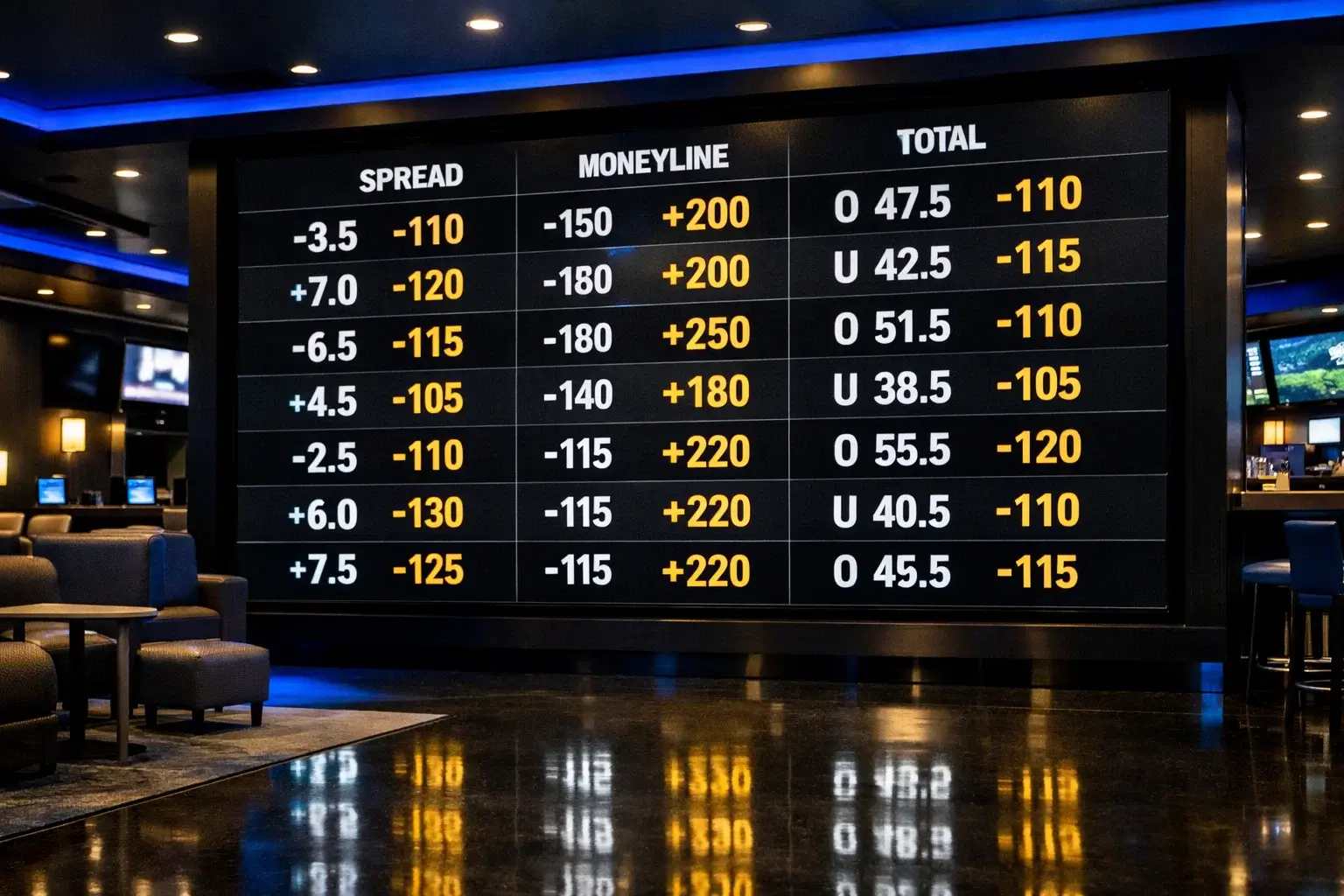
American odds dominate the US betting market. The format uses positive and negative numbers to express the relationship between stake and potential profit.
Negative odds indicate how much you must wager to win $100. If the Bills are listed at -150, you risk $150 to win $100 profit, returning $250 total. The larger the negative number, the heavier the favorite: -300 is stronger than -150.
Positive odds indicate profit on a $100 wager. If the Jaguars are listed at +200, a $100 bet returns $300 total. The larger the positive number, the bigger the underdog: +500 is a longer shot than +200.
The math for calculating payouts is straightforward. For negative odds, profit equals stake divided by the absolute odds value, multiplied by 100. For positive odds, profit equals stake multiplied by the odds, divided by 100. Most sportsbook interfaces display potential payouts automatically.
Consider a practical example. You bet $55 on the Eagles at -3.5 (-110 odds). Your potential profit is $55 divided by 110, multiplied by 100, equaling $50. If the Eagles win by 4 or more, you receive $105. If they win by 3 or fewer, or lose, you lose your $55.
Decimal and Fractional Odds
Decimal odds are standard in Europe, Australia, and most international markets. They represent the total return including your original stake. Odds of 2.50 means every $1 wagered returns $2.50 if you win, for $1.50 profit. Decimal 1.50 corresponds to American -200, while decimal 3.00 corresponds to American +200. Your total return is simply stake multiplied by decimal odds.
Fractional odds remain popular in the United Kingdom. Odds of 5/2 means you win $5 for every $2 staked, plus your original stake. Converting to decimal: divide the first number by the second and add 1. So 5/2 becomes 2.5 + 1 = 3.50 decimal.
For international bettors using multiple sportsbooks, fluency in all three formats prevents costly mistakes. Most online sportsbooks let you toggle between formats in settings.
Understanding Implied Probability
Implied probability separates thoughtful bettors from those who simply pick teams they like. The odds imply a certain probability of each outcome. Your job is determining whether the true probability exceeds the implied probability.
For negative odds, implied probability equals the absolute odds value divided by (absolute odds plus 100). For -150: that is 150 divided by 250, equaling 60%. For positive odds, implied probability equals 100 divided by (odds plus 100). For +200: that is 100 divided by 300, equaling 33.3%.
Adding up implied probabilities in a market exceeds 100%. This excess is the overround, the bookmaker's margin. A typical -110/-110 spread implies 52.4% for each side, totaling 104.8%. That extra 4.8% is the vig in probability terms.
Understanding this transforms bet evaluation. Instead of asking whether the Cowboys will cover, ask whether they have greater than 52.4% chance of covering. If your honest estimate is 55%, you have found a positive expected value bet, regardless of the specific outcome.
Types of Football Bets

Point Spread Betting
Point spread betting is the most popular form of football wagering in the United States. It solves a problem that would otherwise make many games unbettable. If Kansas City is overwhelming favorite against Carolina, a moneyline bet on Kansas City might pay -800. The spread levels the field by requiring the favorite to win by more than a specified margin.
When you see Chiefs -7.5 (-110), you are betting Kansas City wins by 8 or more. If the Chiefs win 24-17, your bet loses because they only won by 7. If they win 28-17, your bet wins because the 11-point margin exceeds the spread. The half-point eliminates pushes, forcing a definitive result.
Key numbers dominate NFL spread betting. Touchdowns are worth 6 or 7 points, field goals worth 3, so final margins cluster around certain numbers. The most common NFL margins are 3, 7, 6, 10, and 14 points. The difference between -3 and -2.5, or +7 and +7.5, is more significant than it first appears. Paying to buy half a point off 3 or 7 is often worthwhile; the same premium on -5 to -4.5 is usually wasted.
College football spreads operate identically but with wider variance due to talent disparity, with spreads routinely exceeding 30 points. In soccer, the equivalent is the Asian handicap. A -1.5 Asian handicap means your team must win by 2 or more goals.
Betting Football Online · NFL Spreads
Point Spread & Key Numbers
Not all half-points are equal. Set a spread and see how often NFL games land on it, whether buying the hook is worth it, and why 3 and 7 tower over everything else.
Moneyline Betting
Moneyline betting returns to the most elemental question: who wins? You pick a team, they either win or they do not. The odds adjust to account for competitive imbalance, making favorites expensive and underdogs lucrative.
The strategic question is whether moneylines offer better value than corresponding spreads. In close games with 1-3 point spreads, the underdog moneyline often provides comparable expected value with lower variance. If you believe the Packers at +3 will either win outright or lose by a touchdown, the +140 moneyline might be more attractive than the -110 spread.
Conversely, moneyline favorites in lopsided games represent poor value. Laying -400 on a regular-season game requires 80% confidence in victory, rarely justified even for elite teams against mediocre opponents.
Soccer moneylines introduce the draw as a third outcome, fundamentally changing the math. The three-way moneyline requires picking among three choices or using alternatives like draw no bet, which refunds your stake if the match ends level.
Over/Under Totals Betting
Totals betting focuses on combined score rather than winner. The sportsbook sets a number, and you wager whether the actual total exceeds or falls short. A total of 47.5 in an NFL game means betting whether the combined final score will be 48 or more (over) or 47 or fewer (under).
Totals attract bettors who prefer focusing on the game's nature rather than picking sides. Two high-powered offenses lighting up the scoreboard regardless of winner favors the over. A defensive struggle in cold weather between conservative teams suggests the under. This removes emotional attachment to particular teams.
Weather significantly impacts totals. Wind reduces passing effectiveness, rain slows play and increases turnovers, cold makes balls harder to grip. Sharp bettors monitor forecasts closely.
Game pace matters enormously. Uptempo offenses running 70 plays each create more scoring opportunities than ground-and-pound teams controlling the clock. Garbage-time scoring can push totals over when competitive games have already been decided.
Parlay Betting
A parlay combines multiple bets into one wager, with all selections needing to win for payment. Instead of -110 on a single spread, combine three teams and get +600. The math works against you, but potential massive returns on small stakes keeps parlays popular.
The issue is that sportsbooks take even larger effective margins. On a two-team parlay, true odds would pay +300 if both legs are coin flips at -110. Most sportsbooks pay +264. This margin compounds with each leg, making long parlays spectacularly bad expected value bets. A 10-leg parlay has negative EV exceeding 40%.
Correlated parlays can offer value. If you expect a blowout, betting the favorite spread plus the under might correlate because winning teams often run the ball and burn clock late. Same-game parlays let you combine related bets within a single contest, though sportsbooks adjust odds to eliminate most correlation value.
The sensible approach treats parlays as entertainment with a small bankroll portion. A $5 three-team parlay paying $25 makes watching games more exciting. A $500 five-team parlay is almost certainly a mistake regardless of confidence level.
Prop Bets and Futures
Proposition bets let you wager on specific occurrences rather than overall outcomes. Player props are most common: Will Mahomes throw over 275.5 passing yards? Will Derrick Henry score a touchdown? These markets leverage specific knowledge about players and matchups not fully reflected in sides or totals.
Player props have exploded in popularity because they engage bettors on a player-by-player basis. The markets are also less efficient because sportsbooks cannot devote equal resources to every prop. Sharp bettors find edges in props that would be impossible on main lines.
Strategy centers on understanding role, opportunity, and matchup. A running back's rushing yards depend on game script: trailing teams abandon the run, leading teams pound it. Researching snap counts, target shares, and defensive tendencies gives you an edge over bettors checking only season averages.
Futures involve wagers on outcomes determined well after betting. Championship odds, betting on Super Bowl or Premier League winners before the season, offer substantial returns but tie up money for extended periods. Futures markets are inefficient early when public perception drives odds more than analysis. The best futures bets are contrarian positions on undervalued teams placed before the season when odds are longest.
Live Betting and In-Play Markets
Live betting allows wagers after games start, with odds updating continuously based on score and flow. A 7-point favorite might become a 3-point underdog after a quick touchdown. The speed and dynamism creates opportunities unavailable pre-game.
The primary advantage is incorporating information revealed during play. How are teams actually playing? Is the injury report accurate? Which offensive line is winning? You observe these in real time rather than guessing from historical data.
However, live betting presents significant challenges. Odds move rapidly, sportsbook algorithms stay ahead of most bettors, and emotional decision-making intensifies while watching games. Many lose money because the format encourages impulsive wagers rather than disciplined analysis.
Successful live bettors develop pre-game plans with specific triggers. For example, if Team A falls behind by 10 in the first half, take them at the adjusted spread because you believe in their second-half adjustments. A framework prevents chaotic game energy from overwhelming judgment.
Football Betting Strategies That Actually Work
Finding Value Through Line Shopping
Line shopping is the single most straightforward way to improve results without additional football knowledge. Different sportsbooks offer different odds on the same games. Betting at the best available number improves expected value on every wager. Over a season, consistently grabbing extra half-points adds up to thousands of dollars.
Consider this example. The 49ers are -3 at Sportsbook A and -2.5 at Sportsbook B. Betting at -2.5 gives extra cushion for the same risk. NFL games land exactly on 3 about 9% of the time. That means approximately 9% of games where you push at Sportsbook A but win at Sportsbook B. Over 100 such bets, line shopping saves 4-5 units.
To shop effectively, maintain accounts at multiple sportsbooks. Major legal US books shade lines differently. Access to five or six options ensures you rarely bet into bad numbers. Odds comparison sites aggregate lines in real time.
The cost of not line shopping is essentially a voluntary tax. Serious bettors consider it malpractice to bet without checking alternatives. Even casual bettors benefit from 30 seconds on a comparison site before placing wagers.
Understanding and Exploiting Market Inefficiencies
Market efficiency describes how accurately prices reflect true underlying value. In highly efficient markets like NFL primetime spreads, finding edges is difficult because thousands of sharps have already incorporated available information. In less efficient markets, opportunities exist.
College football offers more inefficiencies than the NFL. The sheer team count means sportsbooks cannot analyze each matchup as deeply. Regional biases cause over- or underbetting based on fan loyalty. Information asymmetries exist because local reporters may know more than national oddsmakers.
Player props represent another inefficient market. Sportsbooks set hundreds of props per slate and cannot devote equal resources to each. If you have specific expertise on a team or player, you may spot obviously wrong lines that have escaped correction.
The key is identifying your comparative advantage. You will never out-handicap syndicates on Sunday night NFL games using public information. But deeply following a specific conference, tracking ignored metrics, or noticing lazy numbers creates value others overlook.
The Discipline of Expected Value Thinking
Expected value (EV) is the mathematical framework separating professionals from recreational gamblers. A positive EV bet is one where your estimated winning probability exceeds the implied probability in the odds. Over many positive EV bets, you profit regardless of short-term variance. Negative EV bets cost money over time no matter how well you pick short-term.
Calculating EV requires honest probability estimation. If the spread implies 52.4% chance of covering, do you genuinely believe true probability is higher? Not what you hope, not what would be exciting, but your actual best estimate. Most recreational bettors never perform this analysis.
The emotional challenge is accepting that you will lose many individual bets even when making correct decisions. A 55% edge means losing 45% of wagers. Variance produces extended losing streaks. The discipline is trusting math and continuing positive EV bets when results temporarily suggest otherwise.
Professional bettors track meticulously to verify their edge remains. If you consistently identify positive EV bets and still lose over hundreds of wagers, either your estimates are wrong or you are experiencing variance. Data tells you which explanation is more likely.
Managing Your Bankroll Like a Professional

Setting Your Bankroll and Unit Size
Your bankroll is money allocated specifically for betting, separate from living expenses. This is not checking account money. This is money you can afford to lose entirely without affecting your life. If losing your bankroll would cause hardship, it is too large.
Once established, divide your bankroll into units. A standard unit is 1% of total bankroll, so $1,000 translates to $10 units. Conservative bettors use 1%; aggressive bettors might use 2-3%. Going above 5% is reckless because normal losing streaks could devastate your bankroll before your edge manifests.
Unit sizing serves two purposes. First, it normalizes bets so you can track performance accurately. Second, it enforces discipline against betting too large on any single game. The temptation to chase losses or double down on "sure things" is powerful, and unit sizing provides structured defense.
Adjust unit size as your bankroll changes. If $1,000 grows to $1,500, your unit becomes $15. If it shrinks to $700, your unit becomes $7. This dynamic approach prevents overextension when running cold or underbetting when running hot.
The Case Against Chasing Losses
Chasing losses is the single most destructive behavior in sports betting. It happens when you lose and immediately place larger bets trying to recover. This creates a vicious cycle where losing streaks compound into catastrophic damage. Almost everyone who has gone broke can point to a chase session where discipline collapsed.
The psychology is understandable. Losses feel like deficits needing correction. But the math is merciless. Doubling your bet after a loss does not change the second bet's expected value. If both bets are negative EV, you accelerate losses. If positive EV, you still take unnecessary risk by betting too large.
The antidote is accepting losses as inevitable costs. Even sharps lose 45% of wagers. A single loss tells little about long-term edge. Treating each bet as independent, rather than part of an ongoing recovery narrative, eliminates chase-inducing pressure.
If you cannot resist chasing, consider mechanical barriers. Set daily or weekly loss limits after which you stop regardless of remaining games. Use separate accounts with limited deposits to prevent impulsive access to additional funds.
Record Keeping and Analysis
Tracking bets is not optional for serious betting. At minimum, record date, game, bet type, odds, stake, and result for every wager. More detailed tracking includes estimated probability, closing line, and reasoning notes. This data becomes invaluable for identifying patterns.
Closing line value (CLV) is one of the most important metrics. The closing line is final odds before kickoff, after all sharp money has been incorporated. If lines consistently move in your favor by game time, you are likely making positive EV bets even if results have not caught up. Conversely, consistent movement against you suggests your bets were overpriced.
Regular analysis reveals strengths and weaknesses you might not otherwise notice. Maybe you crush player props but lose on totals. Maybe college picks are strong but NFL record is poor. This self-knowledge lets you double down on strengths and address weaknesses.
Plenty of free and paid tools exist for tracking, from spreadsheets to sophisticated apps calculating CLV and statistics. The specific tool matters less than the commitment to honest recording and review.
Common Football Betting Mistakes
Overvaluing Recent Performance
Recency bias is overweighting recent events when forming expectations. In betting, this manifests as overreacting to a team's last game while ignoring longer-term patterns. The team that won 38-3 looks invincible; the team that lost by 20 looks hopeless. These impressions often prove incorrect.
NFL and college seasons are short, and small samples create enormous variance. A team might outperform its true talent for three games due to turnover luck or schedule softness. Lines adjust to reflect results, often overshooting as the public piles on hot teams. Fading recency bias means betting against teams riding unsustainable streaks and on teams whose struggles mask underlying quality.
The counterpoint is that sometimes recent performance reflects real changes. A team that benched its quarterback for a more capable backup might genuinely be better. Distinguishing signal from noise requires understanding why performance changed, not just that it changed.
Ignoring Situational Factors
Situational handicapping considers context beyond Xs and Os. Is this a revenge game? Is a team looking ahead to a more important matchup? Did a team travel across time zones on a short week? These factors influence performance in ways basic statistics do not capture.
Some situations are well-documented enough that the market accounts for them. Primetime home underdogs have historically performed well enough that edges have mostly been arbitraged away. Other situations remain undervalued because they are harder to quantify.
The trap is attributing too much predictive power to narratives. The revenge storyline is compelling, but professionals prepare seriously every week regardless of opponent. Situational factors should adjust probability estimates marginally, not dominate your process.
Betting with Your Heart Instead of Your Head
Betting on your favorite team is almost always a mistake. Emotional investment clouds judgment, making objective assessment difficult. You know too much about their promising young players and too little about their exploitable weaknesses. Sportsbooks know fan money flows toward popular teams and adjust lines accordingly.
The problem is overestimating your team's probability while experiencing outsized emotional pain when they fail. You get bad bets and bad feelings. Many sharps have standing rules against betting teams they follow as fans.
If you insist on betting your team, acknowledge your bias. Consider what a neutral observer would think. Better yet, imagine betting the opponent: at what line would you feel comfortable taking the other side? If that number differs substantially from the actual line, fan bias is distorting your analysis.
Advanced Concepts for Serious Bettors

Reading Line Movement
Line movement is the change in odds between opening and kickoff. Lines move in response to betting action, injury news, weather updates, and other information. Learning to read movement helps you understand what sharps think and time your wagers effectively.
Sharp money typically moves lines early in the week, as professionals bet large amounts before the public reacts. If a line opens at -3 and moves to -4 by Tuesday with no news, sharps likely believe the favorite is undervalued. If a line moves from -7 to -6 despite public money on the favorite, sharps are probably on the underdog.
The challenge is that you cannot see actual money composition. You infer sharp versus public action based on direction, timing, and the relationship between betting percentages and movement.
Reverse line movement occurs when a line moves away from the majority-bet side. If 70% of tickets are on Team A but the line moves toward Team B, the 30% backing Team B represent larger or sharper bets. This pattern often identifies value, though it is not a guaranteed system.
Steam Moves and Market Signals
A steam move occurs when multiple sharp bettors hit the same side simultaneously, causing rapid line movement across the market. When sharp consensus forms, odds change quickly and dramatically. Identifying steam in real time is difficult for recreational bettors, but recognizing when you have missed one helps avoid betting into already-moved numbers.
Market signals extend beyond individual games. If sharps consistently take unders early in the season, the market might be slow to adjust to league-wide scoring trends. These meta-patterns are difficult to exploit directly because they are widely known and increasingly priced in, but they inform your general approach.
The betting market is an information aggregation mechanism. If you believe a line should be -7 but the market has it at -3, the default assumption is that you are missing something. Sometimes you do have superior information, but those instances are rarer than most bettors believe.
Building Simple Models
Quantitative models range from spreadsheet projections to machine learning systems processing thousands of variables. You do not need an advanced degree to build useful models, but you need a systematic approach.
A simple power rating system assigns numerical strength values to each team, then projects spreads based on rating differences plus home field advantage. Update ratings after each game based on results, incorporating margin of victory with regression for fluky games. This basic framework outperforms most casual handicapping because it forces consistency and removes emotional biases.
The value of modeling is not that your model will beat the market. Sportsbooks have better data and smarter people. The value is that building a model teaches you what variables matter and provides a baseline. When your model disagrees with the market significantly, you have identified a game worth investigating.
Many bettors use models as one input among several. The model might suggest Miami +4.5 is fair, the market has them at +4.5, and your qualitative assessment agrees. Each element pointing the same direction increases confidence.
The Psychology of Winning and Losing
Successful bettors manage emotions as rigorously as money. Winning streaks breed overconfidence and reckless sizing. Losing streaks create despair and tempt strategy abandonment. Neither extreme helps long-term results.
Outcome-oriented thinking is the enemy. A correctly evaluated bet can still lose; a poorly reasoned bet can still win. Judging decisions by results rather than process leads to wrong conclusions. The bettor winning a 5-leg parlay is not vindicated; they got lucky.
Taking breaks after significant wins or losses resets your emotional baseline. Many bettors find their worst decisions come immediately after big results. Building in mandatory cool-off periods prevents emotional contamination.
Finally, remember betting should be enjoyable. If you find yourself anxious, obsessive, or unable to stop thinking about bets, the activity has crossed from entertainment to problem. The best bettors maintain perspective, treating betting as a challenging game rather than validation of their worth.
Conclusion
Football betting rewards knowledge, discipline, and patience. You need to understand the games you are betting, the markets you operate in, and the underlying math. You need discipline to bet within your bankroll, resist emotional decisions, and accept losses. You need patience to let your edge compound over hundreds of bets rather than expecting immediate riches.
This guide provides a foundation, but reading alone does not make anyone a winner. Application matters. Track your bets meticulously. Develop a system for evaluating value rather than picking teams you like. Line shop religiously. Treat parlays as entertainment. Constantly reassess whether your approach works.
Most importantly, know yourself. If you lack temperament for losing streaks, bet smaller or do not bet. If you cannot resist chasing, implement mechanical stops. If you consistently lose betting your favorite team, stop betting them. Self-awareness prevents the mistakes that bankrupt recreational bettors.
The sportsbooks always have structural advantages, but those advantages do not make profitable betting impossible. They make it difficult, which is exactly why edge-seekers find the challenge worthwhile.
Frequently Asked Questions
How does football betting work for beginners?
Football betting works by placing wagers on game outcomes through licensed sportsbooks. You will encounter three primary bet types: point spreads where you bet whether a team wins by more or fewer points than a specified margin, moneylines where you pick the winner, and totals where you bet on combined score being over or under a set number. The sportsbook sets odds determining your potential payout and takes a commission called the vig, typically around 10%, on losing bets. To start, create an account at a legal sportsbook, deposit funds, and begin with small wagers on bet types you understand. The learning curve involves understanding odds, recognizing the difference between value and entertainment bets, and developing bankroll management discipline.
What are the most important factors when choosing which football bets to make?
The most important factors are value, bankroll management, and honest self-assessment. Value means identifying bets where your estimated winning probability exceeds the implied probability in the odds, not just picking teams you think will win. A -300 favorite might win 70% of the time but still be a bad bet if odds imply 75%. Bankroll management means betting consistent unit sizes, typically 1-3% of your funds per wager, and never chasing losses. Self-assessment means recognizing your areas of knowledge and ignorance, acknowledging biases, and tracking results to verify your approach works. Secondary factors include line shopping, understanding situational factors, and avoiding emotional bets on teams you follow as a fan.
Can you actually make money betting on football long-term?
Yes, but it is considerably harder than most realize. The vig means you need to win approximately 52.4% of standard spread bets just to break even. Achieving a 55% win rate requires genuine analytical edge, information the market lacks, or identification of consistently inefficient markets. Most recreational bettors lose because they bet impulsively, ignore bankroll management, chase losses, and overestimate their abilities. Profitable bettors treat it as a disciplined practice: tracking every bet, analyzing results, specializing in specific markets, and accepting that short-term variance tells nothing about true edge. With realistic expectations, solid fundamentals, and willingness to work, profitability is achievable. Expecting quick riches without effort means the sportsbooks will happily take your money.
