
Every sportsbook line is a statement of opinion disguised as a number. When a sportsbook prices the Green Bay Packers at -160 on the moneyline, it is not just offering you a bet. It is telling you, in precise mathematical terms, how likely it believes a Packers victory to be. The translation from odds to probability is called implied probability, and it is the single most important analytical tool available to any sports bettor.
Most recreational bettors skip this concept entirely. They look at odds, calculate potential payouts, and decide whether the reward “feels” big enough. That approach is roughly as effective as buying stocks because the company name sounds cool. Understanding implied probability is what separates process-driven bettors from gut-feel gamblers. It turns betting from a guessing game into a decision framework with measurable inputs and outputs.
Calculating Implied Probability from Odds
The conversion formulas are straightforward and apply to all three major odds formats. Since most US bettors work with American odds, those formulas deserve the most attention.
For negative American odds: Implied Probability = |Odds| / (|Odds| + 100). If a team is priced at -200, the implied probability is 200 / (200 + 100) = 200 / 300 = 66.7%. The sportsbook is pricing that outcome as roughly a two-in-three proposition.
For positive American odds: Implied Probability = 100 / (Odds + 100). At +150, the implied probability is 100 / (150 + 100) = 100 / 250 = 40%. The sportsbook estimates this outcome happens four times out of ten.
For decimal odds, the formula is even simpler: Implied Probability = 1 / Decimal Odds. A line of 2.40 implies a 41.7% probability. A line of 1.50 implies 66.7%.
These numbers have a critical nuance that many guides gloss over: they are not the sportsbook’s true estimate of probability. They include the vig. The sportsbook builds its margin into the odds, which inflates the implied probability of every outcome. To find the sportsbook’s actual estimated probability, you need to account for the overround.
The Overround: The Bookmaker’s Built-In Margin
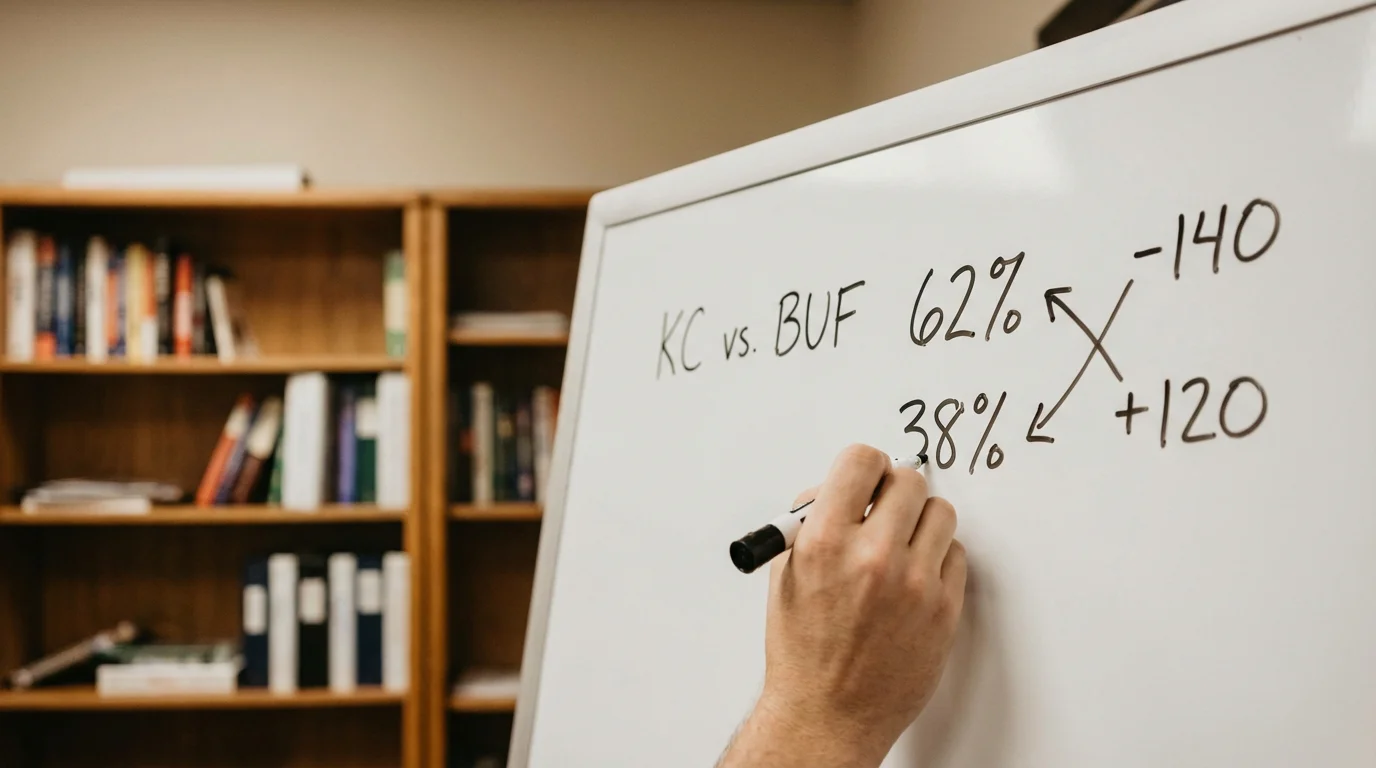
Take a standard NFL moneyline market. The favorite is priced at -180 (implied: 64.3%) and the underdog at +155 (implied: 39.2%). Add those implied probabilities together: 64.3% + 39.2% = 103.5%. In a perfectly fair market, the two sides would add up to exactly 100%. The extra 3.5 percentage points above 100% is the overround, also known as the vig margin or the bookmaker’s edge.
The overround tells you how much of every dollar wagered into that market the sportsbook expects to retain, on average, over time. A 103.5% overround means the sportsbook is keeping roughly 3.5 cents of every dollar bet. A 105% overround is more expensive for bettors. A 101.5% overround, which you might find at a sharp book like Pinnacle on a major NFL game, is significantly cheaper.
To strip the vig and estimate the sportsbook’s true probability for each outcome, divide each side’s implied probability by the total overround. In the example above, the vig-free probability for the favorite is 64.3% / 103.5% = 62.1%, and for the underdog it is 39.2% / 103.5% = 37.9%. Those vig-free numbers add up to 100% and represent a closer approximation of what the sportsbook actually believes about the game.
This distinction matters because it affects how you identify value. If you think a team has a 65% chance of winning and the vig-inflated implied probability is 64.3%, it looks like a marginal edge. But the vig-free probability is 62.1%, which means your true edge is 2.9 percentage points, nearly three times larger than the raw comparison suggested.
Identifying Value Bets: Where Your Edge Lives
A value bet exists when the true probability of an outcome is higher than the implied probability baked into the sportsbook’s odds. That is the entire concept. Everything else in sports betting strategy, from model building to line shopping to handicapping, is ultimately in service of this one goal: finding situations where you believe the real probability exceeds what the sportsbook is charging you.
Suppose you have done your analysis on a college football game and you estimate that the home team has a 55% chance of covering the spread. The sportsbook has them at -110, which implies 52.4% after accounting for the vig. Your estimated edge is 55% minus 52.4% = 2.6 percentage points. That is a value bet. Not because it is guaranteed to win, but because the math is in your favor over a large sample of similar bets.
The practical challenge is obvious: how do you know your probability estimate is accurate? The honest answer is that you never know with certainty. But you can build a process that produces calibrated estimates over time. This involves studying team performance data, tracking your predictions against actual outcomes, and adjusting your methods when they consistently overestimate or underestimate probabilities. The goal is not perfection but accuracy sufficient to overcome the vig.
Here is a useful reality check. If you consistently estimate that outcomes have a 55% probability and they actually occur 55% of the time across hundreds of bets, your model is well-calibrated and you are likely profitable. If you consistently estimate 55% but the outcomes only happen 49% of the time, your model is broken and you are bleeding money despite thinking you have an edge. Tracking your calibration is as important as tracking your win rate.
Expected Value: Putting a Dollar Amount on Your Edge
Implied probability and value are concepts. Expected value puts a concrete dollar figure on them. The expected value (EV) of a bet tells you how much you expect to gain or lose per dollar wagered, on average, over infinite repetitions.
The formula: EV = (Probability of Winning x Profit if Win) – (Probability of Losing x Stake if Loss).
Take the example above. You estimate 55% probability of winning a -110 bet. If you bet $110, the profit on a win is $100.
EV = (0.55 x $100) – (0.45 x $110) = $55.00 – $49.50 = +$5.50.
Over many bets of this type, you expect to earn $5.50 per $110 wagered, which is a 5% return on investment. That may sound small, but in the context of sports betting, a 5% ROI on volume is outstanding. Most professional bettors operate with edges between 1% and 5%.
A negative EV means you expect to lose money on a bet over time. Standard -110 bets where you have no edge at all carry an EV of about -$5.00 per $110 wagered, representing the vig. This is the “tax” every bettor pays by default. Your analytical work has to produce enough edge to overcome this tax and then generate profit on top of it.
Common Mistakes in Probability Analysis
The most dangerous error is confusing an outcome you want to happen with an outcome you believe is probable. Football fans who bet on their own team are particularly susceptible. Fandom creates a cognitive bias that inflates your perceived probability of your team winning. If you are an Eagles fan and you estimate the Eagles at 60% to win every single week, your estimates are not reflecting reality. They are reflecting desire.
Another frequent mistake is ignoring the base rate of your bet type. Point spread bets at -110 require you to win 52.4% of the time to break even. If your analysis consistently produces probabilities between 50% and 53%, you are operating in a zone where the vig eats most or all of your edge. You either need to find better spots with clearer edges or accept that your current analytical process does not generate sufficient separation from the break-even line.
A third mistake is treating implied probability as the sportsbook’s prediction of what will happen, rather than as a price. Sportsbooks set lines to manage risk and balance their books, not to predict outcomes with maximum accuracy. A line can be “wrong” in the predictive sense and still be profitable for the sportsbook because it attracted balanced action on both sides. Your job is to find situations where the price is wrong enough to exploit, not situations where the sportsbook made a “mistake.”
The Probability Lens That Changes Everything
There is a moment in every bettor’s development when odds stop being numbers and start being probability statements. Once you reach that point, the way you interact with sportsbooks changes fundamentally. You stop asking “can this team win?” and start asking “is this team more likely to win than the price suggests?”
That shift is deceptively simple in theory but transformative in practice. It kills the impulse to bet on heavy favorites because they are “safe.” A team at -400, implied 80%, is not safe. It is expensive. If you believe the true probability is 78%, that is a negative EV bet regardless of how good the team is. Conversely, a team at +300 that you estimate at 28% is a value bet even though they are likely to lose. Value does not mean winning. Value means the price is too generous relative to the true probability.
This framework also explains why sharp bettors sometimes take positions that look insane to casual observers. Backing a bad team at +10.5 is not an endorsement of that team. It is a statement that the sportsbook’s spread is wider than the true talent gap justifies. The probability of covering is higher than the odds suggest, and over time, those bets profit even though many of them lose individually. Probability thinking is uncomfortable at first because it requires you to embrace losing bets as an acceptable and expected part of a winning process. But once you internalize it, you will never look at a sportsbook screen the same way again.
