

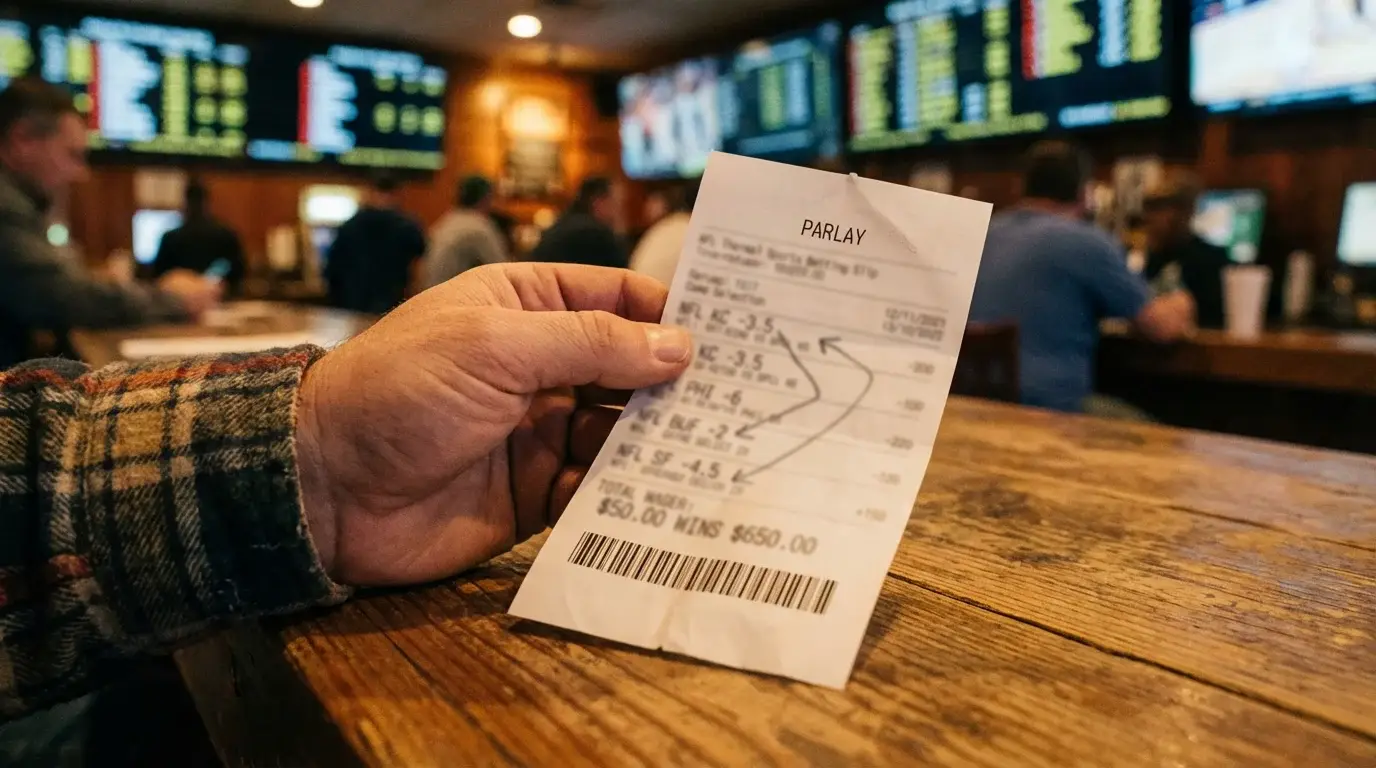
Parlays are the siren song of sports betting. Combine three, four, or five picks into a single bet, and the potential payout multiplies into numbers that look spectacular on a bet slip. A $10 four-leg parlay might return $120. A six-leg parlay might return $500. The allure is obvious, and sportsbooks know it. Parlays are among the most profitable products in the sports betting industry, not because bettors win them frequently, but precisely because they do not.
This is not an article telling you to never bet parlays. That advice, while mathematically sound for most situations, ignores the reality that parlays serve a legitimate purpose for many bettors. What this article does is strip away the mythology, lay out the real math, and define the narrow conditions under which parlays can be a defensible part of a betting strategy.
Calculating Football Parlay Payouts
A parlay links two or more individual bets into a single wager where every leg must win for the bet to pay out. If any single leg loses, the entire parlay loses. The payout is calculated by converting each leg’s American odds to decimal odds, multiplying them together, and then multiplying by the stake.
Suppose you parlay three NFL spread bets, each at -110. The decimal equivalent of -110 is 1.909. The combined decimal odds are 1.909 x 1.909 x 1.909 = 6.958. A $10 bet returns $69.58, which includes your $10 stake and $59.58 in profit. If all three legs were independent coin flips at fair odds, a three-leg parlay should pay 8.00 in decimal (2.00 x 2.00 x 2.00). The difference between 8.00 and 6.958 is the compounding vig, and it is substantial.
Each additional leg amplifies the vig. On a single -110 bet, the vig costs you about 4.8% in overround. On a two-leg parlay, the effective overround is roughly 9%. On a four-leg parlay, it approaches 17%. By the time you reach a six-leg parlay at standard -110 pricing, you are paying an effective margin of roughly 24%. The sportsbook is keeping roughly a quarter of every dollar wagered into six-leg parlays, on average, before you even consider the difficulty of picking six winners.
This compounding effect is the core mathematical argument against parlays. Every leg you add does not just add risk. It multiplies the cost of that risk. The parlay is not six separate bets packaged together. It is a single bet with dramatically worse expected value than any of its individual components.
The Myth of “Locking In” Multiple Winners
The most persistent myth in parlay betting is the idea that combining confident picks into a parlay “locks in” a bigger payout for the same risk. The logic sounds reasonable on the surface: if you are confident in three separate picks, why not combine them into one bet for a bigger reward?
The problem is that confidence does not compound the way odds do. If you are genuinely 55% likely to win each of three independent bets, the probability of winning all three is 0.55 x 0.55 x 0.55 = 16.6%. You have taken three individually positive expected value bets and combined them into a single bet that you lose more than five times out of six. The expected value may still be slightly positive if your edge on each leg is large enough, but the variance has exploded. You are trading a steady stream of small wins for infrequent large payouts punctuated by long losing streaks.
This variance matters for bankroll management. A bettor making straight bets at -110 with a 55% win rate can expect relatively smooth returns over a season. The same bettor turning those picks into three-leg parlays will experience wild swings that feel like random gambling even though the underlying analysis is identical. The math is positive in theory, but the practical experience of losing six or seven parlays in a row can derail discipline and lead to tilt-driven decision-making.
Professional bettors almost universally avoid parlays for this reason. Not because parlays are inherently evil, but because the variance penalty makes it nearly impossible to assess whether your edge is real within a reasonable sample size. With straight bets, a few hundred wagers reveal your true win rate with reasonable confidence. With parlays, you might need thousands of results to distinguish genuine skill from luck, and most bettors do not have the bankroll or patience to reach that sample.
Correlated Parlays: The Exception to the Rule
Not all parlay legs are independent events. When two outcomes are statistically correlated, meaning the occurrence of one increases the probability of the other, a parlay combining those outcomes can offer genuine value. This is the one scenario where parlay math can work in the bettor’s favor.
The classic example in football is combining a team’s spread with the game total. If you believe the Kansas City Chiefs will cover -7, you likely also believe the game will see a fair amount of scoring, because a team covering a touchdown spread has probably scored at least 24 or 28 points. The over is correlated with the favorite covering a large spread. Betting these as a parlay captures a relationship that the sportsbook’s standard parlay calculator, which assumes independence, does not fully price.
Sportsbooks have become increasingly sophisticated at identifying and adjusting for correlations. Same-game parlays, which explicitly allow correlated legs within a single game, use adjusted odds that account for the correlations. But these adjustments are imperfect, and sharp bettors look for spots where the sportsbook’s correlation pricing still leaves value on the table.
Cross-game correlations are harder to exploit because they are weaker and less consistent. The fact that the Packers cover does not meaningfully change the probability that the Dolphins cover in an unrelated game. Legitimate cross-game correlations are rare in football, and building parlays across unrelated games returns you to the standard compounding vig problem.
Same-Game Parlays: The Sportsbook’s Favorite Product
Same-game parlays, or SGPs, have become the most aggressively marketed betting product in the industry. Every major sportsbook promotes them with dedicated tabs, boost promotions, and social media campaigns featuring eye-catching potential payouts. There is a reason for this enthusiasm, and it is not because sportsbooks enjoy giving away money.
SGPs allow you to combine multiple outcomes from a single game: the spread, the total, player props, and game props all in one ticket. The appeal is obvious. You can create a narrative bet: “I think this will be a high-scoring game where the star running back dominates and the underdog keeps it close.” That story translates into a three- or four-leg SGP with an attractive potential payout.
The pricing on SGPs is where the value disappears. Because the legs within a single game are correlated, the sportsbook cannot use standard independent-odds multiplication. Instead, it builds custom odds that account for the correlations and then adds a margin on top. That margin is consistently larger than what you see on standard parlays. Research from multiple betting analytics groups has shown that SGP pricing typically includes an effective margin of 15-25% on a three-leg SGP, significantly higher than the theoretical compounding vig on a standard three-leg parlay at -110.
This does not mean SGPs never win. They do, and the payouts can be thrilling. But the expected value is deeply negative for the vast majority of SGP constructions. The sportsbook has better models for within-game correlations than any individual bettor, and it prices its advantage accordingly. If you bet SGPs, do so with money you have explicitly allocated for entertainment, not with money earmarked for a serious betting strategy.
When Parlays Actually Make Strategic Sense
There are three scenarios where a parlay can be a defensible choice for a thinking bettor. None of them involve the standard “combine my best picks for a bigger payout” approach.
The first scenario is bankroll-constrained bettors seeking higher variance on purpose. If your total bankroll is $100 and you want the possibility of a meaningful payout rather than grinding $5 straight bets for marginal returns, a small parlay bet allocates your limited capital in a way that at least gives you a chance at a significant return. This is not mathematically optimal, but it is practically rational for someone whose straight-bet returns would be trivially small.
The second scenario involves genuinely correlated outcomes where you have identified a pricing inefficiency. As discussed, if two legs of a parlay are positively correlated and the sportsbook’s parlay pricing has not fully accounted for that correlation, the parlay may offer better value than either leg individually. These opportunities are uncommon and require specific analytical work to identify, but they exist.
The third scenario is hedging. A bettor who holds a futures ticket on a team to win the Super Bowl might parlay the opposing team’s moneyline with another bet late in the season to create a hedge that covers multiple outcomes. This use of parlays is a risk-management tool rather than a value-seeking strategy, and it can be mathematically justified when the futures position has grown in value.
Outside of these three scenarios, parlays are entertainment. There is nothing wrong with entertainment. The sports betting industry exists partly because people enjoy the act of wagering. But confusing entertainment with strategy is where bankrolls go to die.
A Disciplined Framework for Parlay Betting
If you choose to include parlays in your betting activity, a disciplined approach limits the damage and preserves the fun.
Allocate a fixed percentage of your bankroll to parlays, typically no more than 5-10%. This is your entertainment budget. When it is gone for the week, it is gone. Do not dip into your straight-bet bankroll to fund additional parlays. The psychological separation between “serious bets” and “fun bets” is critical for maintaining discipline.
Limit your parlays to two or three legs. The compounding vig grows rapidly beyond three legs, and the probability of winning drops to levels where you need exceptional luck even with strong analysis. A two-leg parlay at -110 on each side carries an effective overround of about 9%, which is expensive but not catastrophic. A six-leg parlay at roughly 24% effective overround is a donation.
Avoid parlays built entirely from favorites. The most common recreational parlay is three or four heavy favorites combined because each one “should win.” This is the worst possible construction. The favorites are overpriced individually because of public bias, and the parlay amplifies that overpricing through multiplication. If you must parlay, mixing underdogs with moderate favorites produces better expected value than stacking chalk.
The Honest Payout Table
Before placing your next parlay, consider these approximate true odds and payouts for standard -110 legs. A two-leg parlay pays roughly 2.64 to 1, but the true probability of hitting it with no edge is about 25%, implying fair odds of 3.00 to 1. A three-leg parlay pays roughly 5.96 to 1 against fair odds of 7.00 to 1. A four-leg parlay pays roughly 12.28 to 1 against fair odds of 15.00 to 1.
The gap between the parlay payout and the fair odds represents the compounding vig in concrete terms. On a four-leg parlay, you are being underpaid by roughly 17% compared to what a zero-margin book would offer. That is the sportsbook’s edge, extracted not through some hidden mechanism but through basic multiplication.
These numbers are not meant to forbid you from ever betting a parlay. They are meant to ensure that when you do, you understand exactly what you are paying for the privilege. A parlay is a lottery ticket dressed up in a sports analysis costume. Enjoy it for what it is. Just do not mistake the costume for the reality.
