

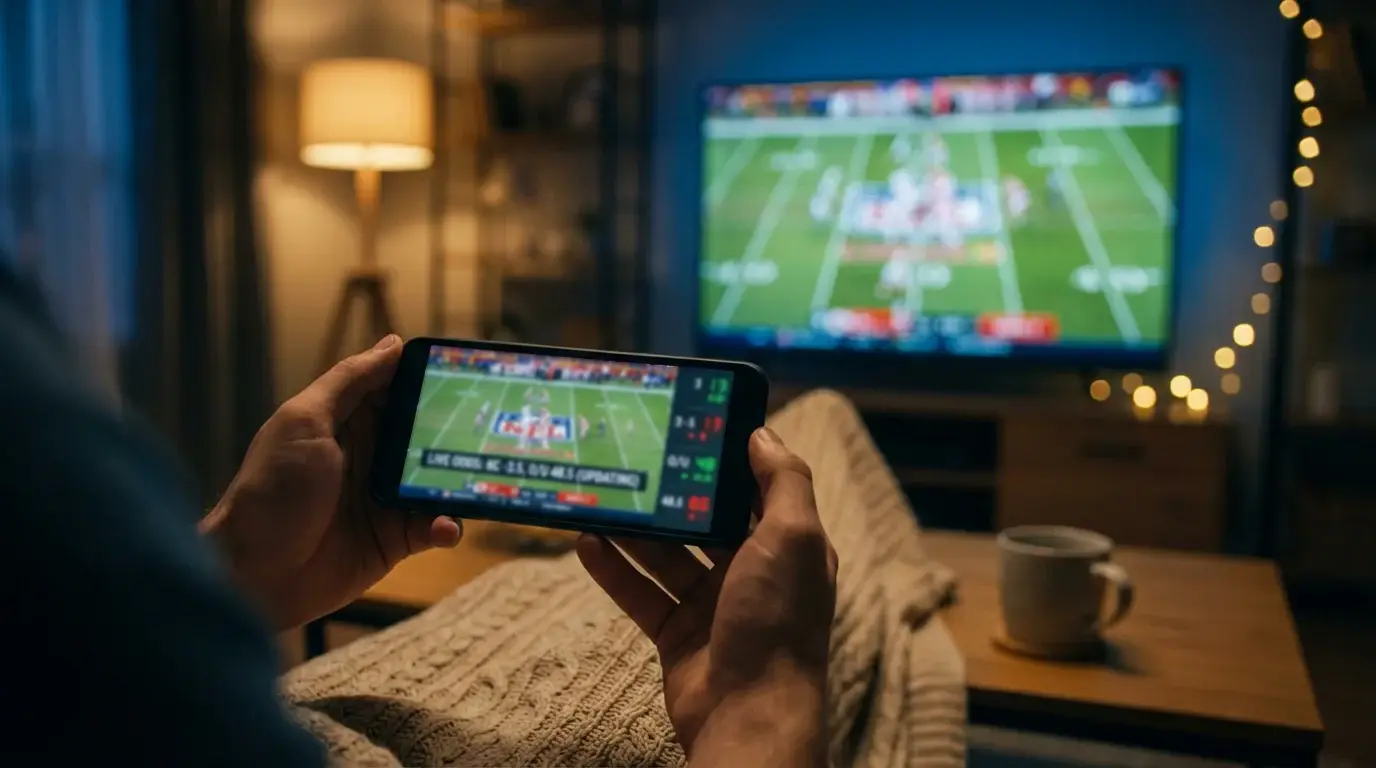
Live betting, also called in-play or in-game betting, lets you place wagers after kickoff while the game is still being played. The odds update continuously based on the score, game clock, field position, and momentum. A team that was a -3 pre-game favorite and falls behind 14-0 in the first quarter might suddenly be a +6 underdog on the live line. The market is moving in real time, and so is the opportunity.
This speed is what makes live betting both thrilling and dangerous. The thrill comes from the feeling that you are reacting to what you see on the field, exploiting momentary mispricing before the sportsbook adjusts. The danger comes from the reality that the sportsbook’s algorithm adjusts faster than your brain does, and the emotional intensity of watching a game while betting on it creates cognitive traps that methodical pre-game bettors rarely encounter.
Live betting is not a casual add-on to your football wagering. It is a distinct discipline with its own skill set, its own analytical framework, and its own bankroll management rules. Treating it as an extension of pre-game betting is the fastest way to erode a well-managed bankroll.
Analyzing the Live Betting Marketplace
Sportsbooks price live markets using automated models that ingest real-time data: score, time remaining, down and distance, field position, timeouts remaining, and sometimes even expected points models derived from play-by-play data. These algorithms are fast and reasonably accurate. They are not perfect, but they are better than any human can be at processing multiple variables simultaneously in the 15 seconds between plays.
The sportsbook’s edge in live betting comes from two sources. The first is speed. When a touchdown is scored, the algorithm reprices the market within seconds. By the time you process the play, decide you want to bet, and click submit, the line may have already moved past the number you saw. This latency disadvantage means that retail bettors are almost always getting a slightly stale price on the most impactful plays.
The second source of edge is wider margins. Live betting spreads and totals typically carry higher juice than pre-game lines. Instead of -110 on both sides, you might see -115 or -120. On moneylines, the gap between the favorite and underdog prices is often wider than pre-game equivalents. The sportsbook charges more because the market moves faster, the risk of mispricing is higher, and the bettor has less time to shop for better numbers.
These structural disadvantages do not make live betting unbeatable. They raise the bar for profitability. You need a larger edge per bet to overcome the wider vig and the latency discount. Finding that edge requires preparation that begins before the game starts.
Pre-Game Planning: The Foundation of Live Betting Success
The most common mistake in live betting is improvisation. A bettor watches the game, sees something they like, and fires a bet on impulse. This reactive approach feels intuitive but is precisely what the sportsbook’s model is designed to exploit. The model is dispassionate and data-driven. The impulse bettor is emotional and anchored to the most recent play they watched.
Successful live bettors plan their entries before kickoff. This means studying the game during the week, identifying specific scenarios that would create value, and defining the price at which they would act. The pre-game plan functions as a decision framework that removes emotion from the live betting process.
A typical pre-game plan might look like this: “If the Packers fall behind by 10 or more points in the first half, I will take them on the live spread if I can get +7 or better. My pre-game power rating has the Packers as a 2-point favorite, and I believe the market will overreact to a slow start.” This plan identifies the trigger (falling behind by 10), the entry point (+7 or better), and the reasoning (power rating discrepancy). If the trigger never fires, no bet is placed. If the trigger fires but the live spread is only +5, no bet is placed. The plan is specific enough to be actionable and disciplined enough to prevent chasing.
Building these pre-game plans requires the same analytical work that goes into pre-game betting: power ratings, matchup analysis, and situational evaluation. The difference is that you are projecting not a single pre-game number but a range of scenarios and the prices you would accept in each one.
Trigger-Based Entry Points: When to Strike
Not every moment in a football game offers live betting value. Most of the time, the live line is priced efficiently and betting into it costs you vig without providing an edge. Value concentrates around specific game situations where the live algorithm tends to misprice or where public behavior creates a temporary distortion.
The most reliable trigger is an early deficit for a pre-game favorite. When a team that was favored by 3 points falls behind 10-0 in the first quarter, the live spread often overreacts. The algorithm correctly incorporates the current score, but it can underweight the favorite’s pre-game talent advantage and the mean-reversion tendency of NFL and college games. A 10-point deficit with 45 minutes of game clock remaining is not a death sentence for a quality team, but the live line often prices it as though the trailing team’s chances have diminished more than the data supports.
Another productive trigger is a turnover on a deep drive. If a team drives from its own 20-yard line to the opponent’s 15 and then fumbles, the scoring opportunity is lost but the underlying offensive performance was strong. The live line adjusts for the turnover, but it may not fully credit the offensive efficiency that produced the long drive. If you were planning to bet on that team and the turnover creates a better price, the fumble has not changed your analysis of team quality. It has changed the short-term score.
Weather-related triggers work particularly well for totals. If a game starts in calm conditions and the total is 48, but weather data shows a storm front arriving in the second half with 20-mph winds and rain, the live total may not adjust quickly enough for the expected scoring suppression. Bettors who monitor weather radar during outdoor games have a real-time information edge over algorithms that may not incorporate granular weather changes in their live total adjustments.
Halftime is a consistently productive window for live betting. The sportsbook’s live model resets at halftime, and the second-half lines are set based on both the first-half data and pre-game projections. If you believe the first half was unrepresentative of the true matchup, whether due to a fluke turnover, a special teams breakdown, or an abnormal game flow, the halftime line can offer value that reflects the anomalous first-half result without fully accounting for the expected regression in the second half.
Managing the Speed: How to Avoid Getting Burned
The pace of live betting creates psychological pressures that do not exist in pre-game betting. The odds change every few minutes. A price you liked three plays ago is gone. The temptation to chase a number that just moved away from you is intense, and giving in to that temptation is one of the most common and costly mistakes in live betting.
Chasing in live betting happens when you see a price you want, hesitate, watch it move against you, and then bet anyway at the worse number because you feel committed to the position. This behavior is driven by loss aversion: the feeling that missing out on a bet you “should have” placed is a loss. It is not. A bet not placed has zero expected loss. A bet placed at a bad number has negative expected value. Walking away from a missed number is always better than chasing it.
The practical defense against chasing is the pre-game plan described above. Your plan specifies the trigger and the price. If the price is not available when the trigger fires, you do not bet. Period. No exceptions, no rationalizations about how -105 is “close enough” to +100. The plan is the plan. Deviating from it under the emotional pressure of a live game is how disciplined bettors become undisciplined bettors one click at a time.
Bet sizing in live betting should also follow strict rules. Many bettors increase their live bet size after a loss, trying to recover their pre-game losses with a well-timed in-game play. This is the same loss-chasing behavior that destroys bankrolls in pre-game betting, compressed into a three-hour window where the emotional intensity is amplified. Flat staking at a fixed percentage of your bankroll, regardless of your pre-game results, is the only sizing approach that prevents emotional escalation.
The Emotional Trap of Watching and Wagering
There is a reason casinos pump oxygen and remove clocks. The environment is designed to alter your decision-making. Live betting on your couch creates a milder version of the same effect. You are watching a game you care about, your adrenaline is up, and the sportsbook is offering you immediate action with a single tap.
This environment is hostile to rational analysis. Every big play triggers an emotional response, and that response is exactly what the sportsbook’s pricing model is designed to exploit. A long touchdown makes the scoring team look dominant, and the live line shifts to reflect the new score. Your brain says “that team is rolling” and encourages you to back them. The algorithm, meanwhile, has already priced in the touchdown and moved the line past the point of value.
The bettors who profit from live betting are not the ones who react to what they just saw. They are the ones who anticipated what might happen and defined their action in advance. They watch the game not as fans but as analysts waiting for pre-identified conditions to materialize. This mindset requires a kind of emotional discipline that is genuinely difficult to maintain while watching football. If you find that you cannot maintain analytical detachment during a game, live betting is probably not for you, and that is a perfectly reasonable conclusion. Not every betting market suits every bettor, and knowing which ones to avoid is as valuable as knowing which ones to target.
Your Personal Latency as an Honest Metric
Here is a practical self-assessment exercise. The next time you consider a live bet, note the time between the triggering event and the moment you click submit. If that gap is less than 30 seconds, you are almost certainly reacting rather than analyzing. A genuine analytical process requires evaluating the trigger against your pre-game plan, checking the current line against your target price, and confirming that your reasoning still holds given the game context.
If you consistently find that your live bets are placed within seconds of a triggering event, your process is not a process. It is a reflex. Reflexive betting in live markets is the sportsbook’s ideal customer behavior, because reflexes are predictable and exploitable. The fix is not to react faster. It is to plan better before the game starts and to use the plan as a speed brake during the game. A 60-second delay between trigger and execution might cost you the occasional number, but it will save you from the far greater cost of impulsive bets placed on emotion rather than analysis. The few dollars you lose to latency are nothing compared to the hundreds you save by not chasing.
