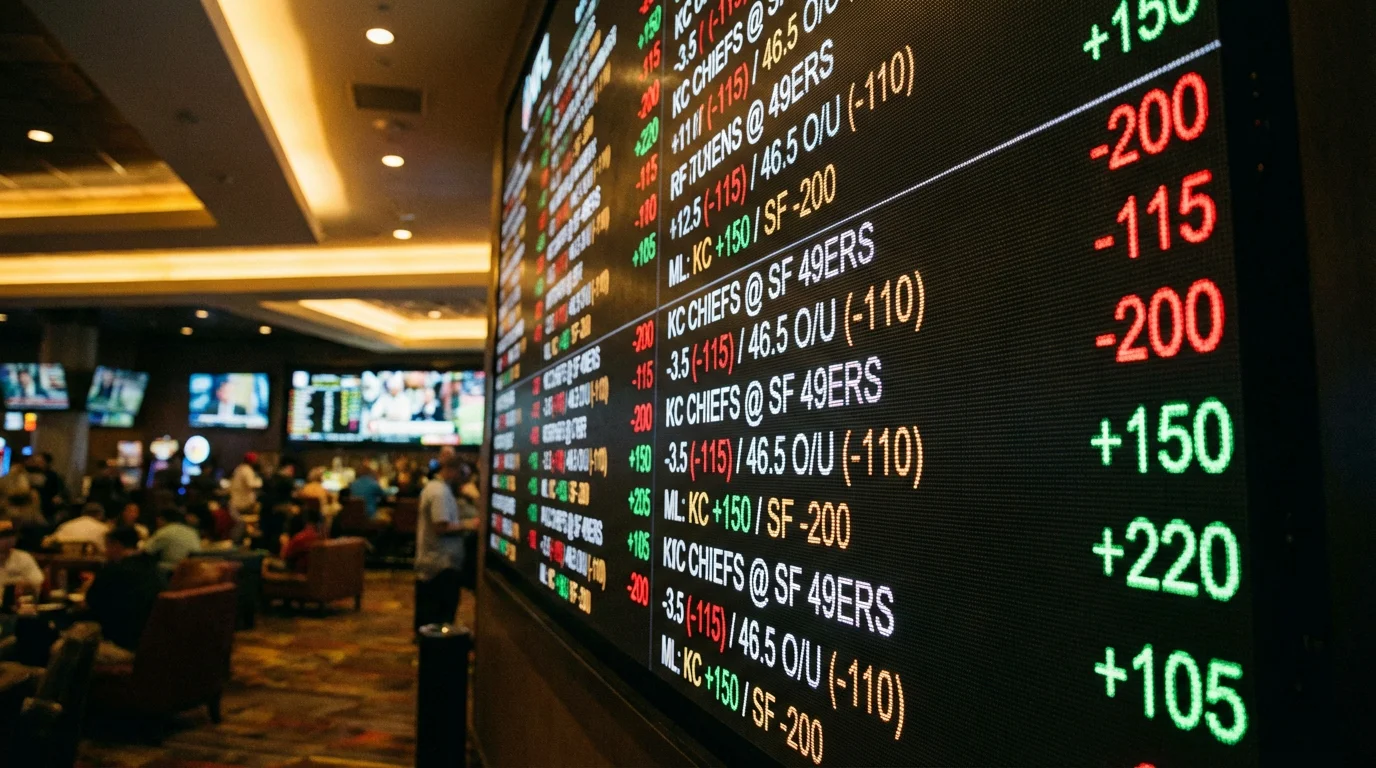
Every number on a sportsbook screen is trying to tell you something. American odds, the format used by virtually every US-facing sportsbook, communicate two things at once: which side is favored and how much you stand to win or risk. The system is elegant once you crack it, but it confuses almost everyone on first contact because it uses two different scales depending on whether a number is positive or negative.
This is not a system designed to confuse you, though it does a fine job of that accidentally. American odds evolved from the way bookmakers historically quoted prices, and they persist because the US market prefers them. Once you internalize the logic, you will read a line like Chiefs -155 / Bills +135 as fluently as you read a price tag at a grocery store.
Understanding Negative American Odds
A negative number in front of a team or outcome tells you two things instantly. First, that side is the favorite. Second, the number represents how much you need to risk to win $100 in profit. If you see the Philadelphia Eagles listed at -180 on the moneyline, the sportsbook is saying: put up $180, and if the Eagles win, you get $100 in profit plus your $180 back, for a total payout of $280.
The larger the negative number, the heavier the favorite. A -110 line is close to a coin flip, which is why you see it on both sides of most spread bets. A -300 line means the sportsbook considers that outcome very likely, and you are paying a steep premium for the privilege of betting on it. A -600 line is a massive favorite, and the risk-reward ratio becomes uncomfortable for most bettors: you are laying $600 to win $100.
Negative odds also appear on point spreads and totals, not just moneylines. When you see a spread of Chiefs -3.5 (-110), the -3.5 is the spread itself and the -110 is the price. Both sides of a standard spread bet are typically priced at -110, meaning the sportsbook charges the same commission regardless of which team you back. When one side moves to -115 or -120 while the other shifts to -105 or +100, the sportsbook is adjusting prices to balance the money coming in on each side.
The Plus Sign: What Positive Odds Mean
Positive odds mark the underdog and tell you how much profit you would earn on a $100 stake. If the Jacksonville Jaguars are listed at +240, a $100 bet returns $240 in profit plus your $100 stake back for a total of $340. The higher the positive number, the bigger the underdog and the larger the potential payout.
Positive odds offer the psychological appeal that keeps recreational bettors coming back. A $20 bet at +500 pays $100 in profit. That feels exciting, and it is designed to. But the implied probability of a +500 outcome is roughly 16.7%, meaning the sportsbook estimates that result will happen less than one time in six. The big payouts are big precisely because the outcomes are unlikely.
You will also encounter positive odds on spread bets when one side becomes a slight favorite in the market. If a spread moves from a pick ’em to Team A -1, the adjusted pricing might show Team B +1 (-105) and Team A -1 (-115). In that scenario, Team B is a slight underdog by one point, and the pricing reflects a small edge toward Team A. These subtle price shifts matter more than most beginners realize. Over a full NFL season of betting, the difference between consistently getting -105 instead of -110 on your picks is substantial.
Calculating Payouts: The Actual Math
The formulas for converting American odds to payouts are simple but different depending on the sign.
For negative odds, use this: Profit = (Stake / Absolute Odds Value) x 100. If you bet $50 at -150, your profit is (50 / 150) x 100 = $33.33. Your total payout is $83.33.
For positive odds: Profit = (Stake x Odds Value) / 100. If you bet $50 at +200, your profit is (50 x 200) / 100 = $100. Total payout: $150.
These calculations become second nature after a few weeks. But you do not need to do them manually. Every sportsbook displays the potential payout on your bet slip before you confirm the wager. The reason to understand the math is not to replace the calculator but to develop intuition. When you see -145 odds, you should instinctively know that the sportsbook considers that outcome roughly 59% likely. When you see +180, you should sense that the implied probability is around 36%. This intuition is the foundation for identifying value, which is the entire game.
Practical Examples: NFL and College Football Lines
Let us walk through a real-world scenario. It is Week 8 of the 2026 NFL season, and the board shows the following for a Sunday afternoon game:
Dallas Cowboys at Detroit Lions Spread: Lions -4.5 (-110) / Cowboys +4.5 (-110) Moneyline: Lions -200 / Cowboys +170 Total: 48.5 (Over -110 / Under -110)
If you bet $55 on the Lions to cover -4.5 at -110, you win $50 in profit if the Lions win by 5 or more points. If they win by 4 or fewer, or lose outright, you lose $55. If you instead take the Cowboys moneyline at +170 for $30, you win $51 in profit if Dallas wins the game outright, regardless of the margin. If Dallas loses, your $30 is gone.
College football lines often look different in scale but work identically in structure. A game between Alabama and a mid-major program might show Alabama -28.5 (-110) with a moneyline of -5000. That moneyline price is so extreme that nobody bets it straight. You would risk $5,000 to win $100. The spread, even at nearly four touchdowns, is where the real action goes. The same American odds rules apply: -110 means risk $110 to win $100 on either side of that 28.5-point number.
The differences between NFL and college lines matter for strategy, but the odds format is identical. Whether the spread is 1.5 or 35.5, the pricing tells you the same thing: how much you risk and how much you stand to win.
Converting American Odds to Implied Probability
This is where American odds become a decision-making tool rather than just a pricing format. Every set of odds implies a probability, and comparing that implied probability to your own estimate of the true probability is how you find value.
For negative odds, the formula is: Implied Probability = Absolute Odds Value / (Absolute Odds Value + 100). At -150 odds, the implied probability is 150 / (150 + 100) = 150 / 250 = 60%. The sportsbook is pricing that outcome as a 60% likelihood.
For positive odds: Implied Probability = 100 / (Odds Value + 100). At +200, the implied probability is 100 / (200 + 100) = 100 / 300 = 33.3%.
Here is the critical detail: if you add up the implied probabilities of all outcomes in a market, the total will exceed 100%. In a two-way market like a moneyline between two teams, you might see -150 and +130. The favorite implies 60%, and the underdog implies 43.5%. That adds up to 103.5%, not 100%. The extra 3.5% is the overround, which represents the sportsbook’s built-in margin. Every dollar bet into that market, on average, returns less than a dollar. The overround is the vig expressed as a probability surplus.
Understanding overround lets you compare sportsbooks on a fundamental level. A book offering -105 on both sides of a spread has a 2.4% overround. A book offering -110 on both sides has a 4.8% overround. Over a season of heavy betting, that difference is the gap between marginal loss and marginal profit.
Common Mistakes New Bettors Make with American Odds
The most frequent error is confusing the spread with the odds. When a bettor sees Chiefs -3.5 (-110), they sometimes believe they are risking $3.50 or that the -110 modifies the spread somehow. The spread and the price are two independent pieces of information displayed next to each other. The spread tells you the handicap. The odds tell you the cost.
Another common mistake is ignoring the difference between -110 and -115 because “it is only five dollars.” On a single bet, sure, the impact is minor. But over 500 bets in a season, paying -115 instead of -110 on every wager costs you thousands of dollars in additional vig. Professional bettors are obsessive about price because they understand the compounding effect of even small pricing edges over a large sample.
A third mistake involves parlays and the misperception that American odds multiply in a straightforward way. They do not. Parlay payouts are calculated by converting each leg to decimal odds, multiplying them together, and then converting back. Sportsbooks display parlay payouts prominently because the numbers look attractive, but the true probability of hitting a four-leg parlay is significantly lower than most bettors intuitively believe.
The Fluency Test
Here is a practical exercise. Look at these three lines and, before reading further, try to answer the questions that follow.
Line A: Team X -135 Line B: Team Y +275 Line C: Over 52.5 (-120)
How much do you risk to win $100 on Line A? What is your profit on a $50 bet on Line B? What is the implied probability of Line C?
Answers: On Line A, you risk $135 to win $100. On Line B, your profit is $137.50. Line C implies a probability of approximately 54.5%.
If you got all three right without a calculator, you are already reading American odds with functional fluency. If you needed to re-read the formulas, that is fine. Fluency comes from repetition, not memorization. Spend a week scanning the lines for upcoming NFL games, mentally converting them to implied probabilities, and within a month you will process American odds as automatically as you read a speedometer. The format stops being a barrier and starts being a language you speak.
